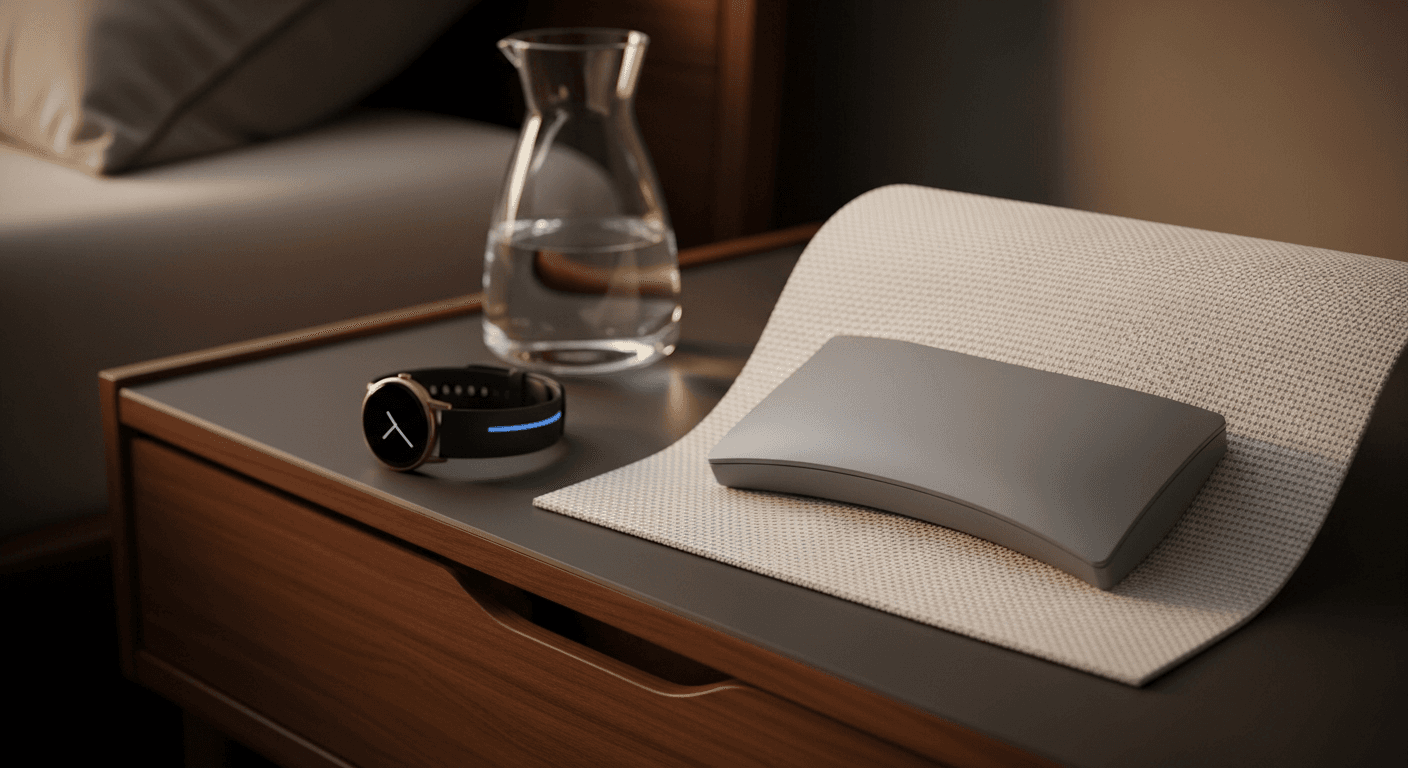
Our verdict: Smart Nora is one of the least intrusive anti-snoring devices because nothing goes in your mouth or on your face. Its microphone listens for early snoring and triggers an inflatable insert beneath your pillow. That convenience comes at a premium price, and it should be treated as a snoring product—not a way to diagnose or treat sleep apnea.
Smart Nora is most appealing to a habitual snorer with a partner who is disturbed by the noise, especially when nasal strips, position changes, and ordinary pillow adjustments have not helped. It is a weaker fit for anyone with suspected sleep apnea, people who wake easily when their pillow moves, or shoppers who want a small travel solution.
What is Smart Nora?
The current Nora Gen 2 system has three main parts:
- Pebble: a bedside microphone and control unit that listens for snoring.
- Inflatable pillow insert: a pad placed beneath your existing pillow.
- Base: an air pump that inflates and deflates the insert when the Pebble detects snoring.
The idea is similar to a partner gently nudging a snorer. The movement changes the head position and may interrupt the vibration producing the sound without requiring the sleeper to wear a mouthpiece or mask. Sensitivity and inflation height can be adjusted.
Quick assessment
| Category | Assessment |
|---|---|
| Comfort | No wearable component, but the pillow movement can disturb light sleepers. |
| Setup | More involved than a nasal strip, simpler than a fitted oral appliance. |
| Evidence | The company publishes validation results; broader independent evidence remains limited. |
| Value | Expensive for a single-purpose device, so the return policy matters. |
| Best for | Primary snoring without signs of a breathing disorder. |
What we like
Nothing to wear
Mandibular devices, tongue retainers, chin straps, and CPAP masks all require direct contact. Nora's contact-free design avoids jaw soreness, facial pressure, and the fitting process associated with wearables.
It works with your existing pillow
The insert sits beneath the pillow rather than replacing it. That helps if you already have a pillow height and material that supports your neck. Very heavy, unusually rigid, or shifting pillows may require more experimentation.
Adjustable response
Snoring volume, room acoustics, partners, pets, and ambient noise differ. Adjustable detection sensitivity and inflation let users reduce false triggers or increase the response when the system misses early snores.
A real home trial
Smart Nora's current terms describe a 30-day money-back period for qualifying direct purchases and a one-year limited warranty. Read the current conditions before ordering, keep every component and the packaging, and start testing immediately so the setup period does not consume most of the return window.
What we do not like
The price is high
Nora Gen 2 is priced in the hundreds of dollars. Promotions change, so compare the final checkout price rather than an advertised discount. The cost is difficult to justify without a usable return option and a clear improvement for both the snorer and partner.
Pillow movement can become the new disturbance
The system is designed to move gently, but a very light sleeper may notice the inflation or pump. A side sleeper can also experience the movement differently from a back sleeper. Start with conservative settings and change one variable at a time.
It requires several components
The bedside microphone, base, hose, insert, and power requirements make Nora less convenient than a strip or simple positional device. Travelers need to pack the full system and recreate the setup.
It treats a sound, not the underlying diagnosis
Snoring can be harmless, but it can also accompany obstructive sleep apnea. Smart Nora states that its products are not medical devices and are not substitutes for medical attention. A quieter room does not prove breathing is normal.
Smart Nora and sleep apnea
Do not use an anti-snoring product to postpone evaluation when warning signs are present. Loud habitual snoring plus witnessed breathing pauses, gasping, morning headaches, high blood pressure, or excessive daytime sleepiness deserves medical attention. The National Heart, Lung, and Blood Institute notes that untreated sleep apnea raises the risk of serious health problems.
If you already use CPAP or another prescribed therapy, do not replace or modify it because Nora reduces noise. Ask your sleep clinician whether pillow movement could interfere with your mask seal or treatment position.
How to test Smart Nora fairly
- Record a baseline. Track several nights of snoring, awakenings, and partner disturbance before installing Nora.
- Follow the placement instructions. Put the insert and Pebble where the manufacturer specifies.
- Use moderate settings first. Maximum sensitivity can create unnecessary activations.
- Adjust over several nights. The company recommends a setup period to find comfortable sensitivity and inflation.
- Measure both sleepers' experience. Reduced sound is not a win if pillow movement causes more awakenings.
- Decide before the return deadline. Include setup, comfort, reliability, and storage—not only one unusually good night.
Alternatives to consider
Side-sleeping or positional support
Snoring often changes with position. A body pillow, wedge, or positional device is simpler and cheaper, though it will not suit every cause of snoring. See our sleep apnea pillow guide for an explanation of where positional support fits—and where it does not.
Nasal strips or dilators
These can help when nasal resistance is a major contributor. They do not address collapse farther down the airway.
Custom oral appliance
A qualified dentist can provide an oral appliance for appropriate patients, including some people with obstructive sleep apnea who cannot tolerate CPAP. Fitting and follow-up matter; generic boil-and-bite products are not equivalent.
Professional sleep evaluation
This is the correct alternative when snoring comes with breathing pauses, daytime impairment, cardiovascular risk, or persistent concern. A sleep study can distinguish ordinary snoring from a disorder that needs treatment.
Who should buy it?
Smart Nora makes the most sense if all of the following are true:
- Your primary problem is snoring rather than diagnosed or suspected sleep apnea.
- You strongly prefer a contact-free device.
- You can leave the system set up beside the bed.
- Your pillow and sleep position work with the insert.
- The current direct-purchase return policy protects the trial.
- The price is reasonable relative to the disruption snoring causes in your household.
Bottom line
Smart Nora is clever, comfortable compared with many anti-snoring devices, and unusually easy to try without wearing anything. It is also expensive, component-heavy, and supported by less independent evidence than we would like at this price. For straightforward snoring, the home trial can answer whether it earns a place in your bedroom. For possible sleep apnea, start with a healthcare professional instead.
Sources and current terms
Found this helpful?
Get more sleep tips and product reviews delivered to your inbox.
Subscribe to 40 WinksRelated reading
Best Place to Buy a Mattress: Online vs. In Store
Compare online brands, showrooms, warehouse clubs, and local stores by trial terms, returns, warranty service, delivery, and total cost.